
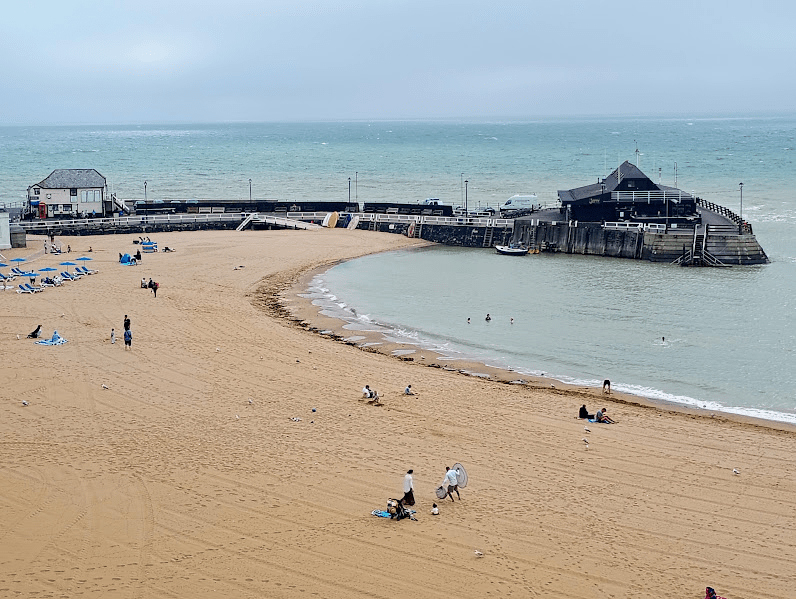
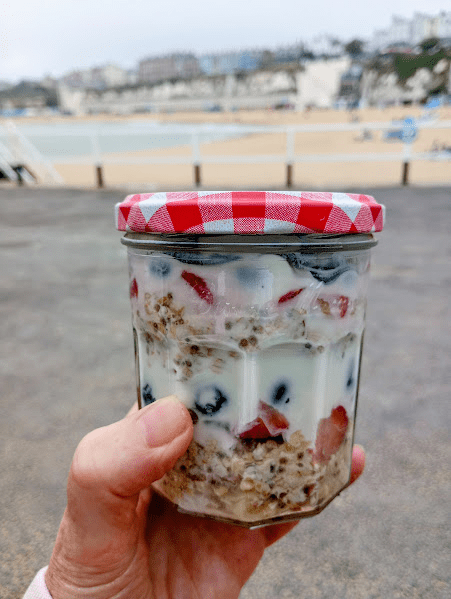
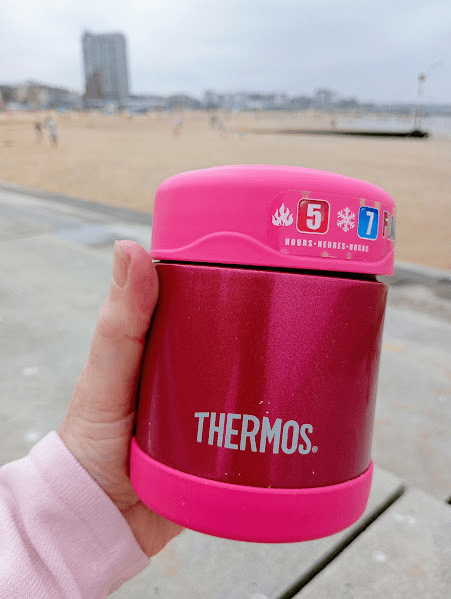
I had been dithering over whether to tackle this next section of walk. It comes in at around 10km and I wasn’t really sure whether I had built up enough stamina to tackle that distance yet. I decided to risk it, take it slowly and have plenty of stops. I was awake early, so packed up my overnight oats, fruit and yoghurt into a jar and headed to the train station. Arriving in Broadstairs, I walked down the High Street to the sea front,
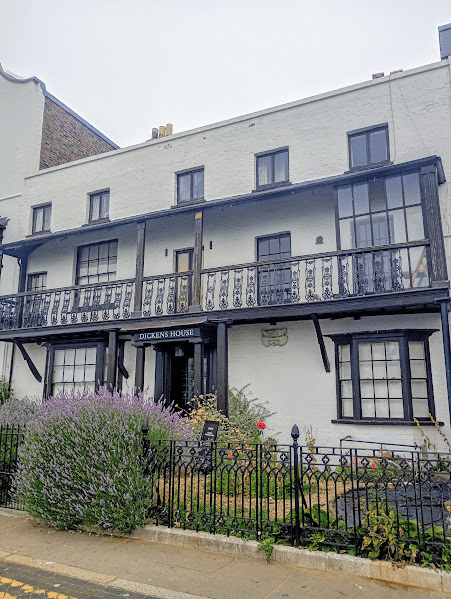
passing the Dickens House Museum (this cliff top house is said to be the inspiration for Betsy Trottwood’s house in David Copperfield),
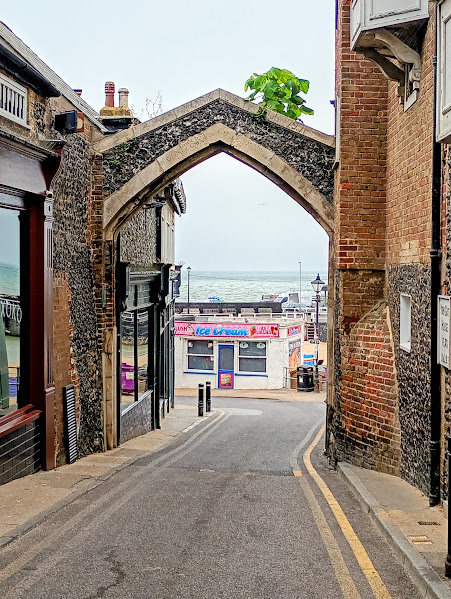
and through the 16th century York Gate to reach the beach.
There I had my first stop of the day, eating my breakfast by the harbour. It had been warm and sunny when I left home, even though it was early, but it was quite chilly with a sea mist by the coast, and I did start to question my al fresco choice.
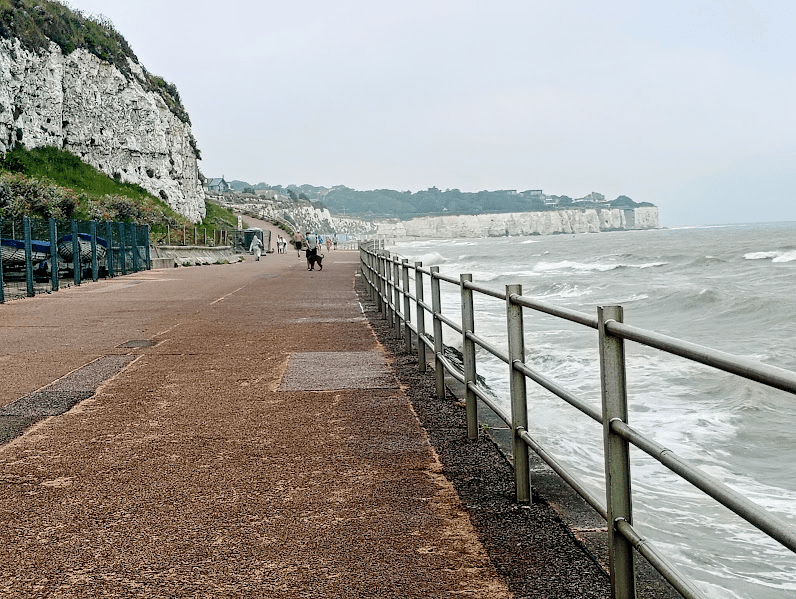
With a section of the coastal walk that would see me passing over half of Thanet’s sixteen sandy bays and beaches, having eaten, I left Viking Bay behind and headed along the prom, taking care not to get wet from the high tide waves that were crashing over the railings. (Viking Bay incidentally, was named in tribute to the replica Viking ship I saw in Part 9 of my Coastal Walk, which landed there in 1949.)
The promenade leads to Stone Bay, lined by colourful beach huts. I don’t know whether any of them are privately owned, but you can hire them on a weekly, seasonal or annual basis. This is such a good idea now that the price of beach huts in Kent – especially in Whitstable – have become so prohibitive.
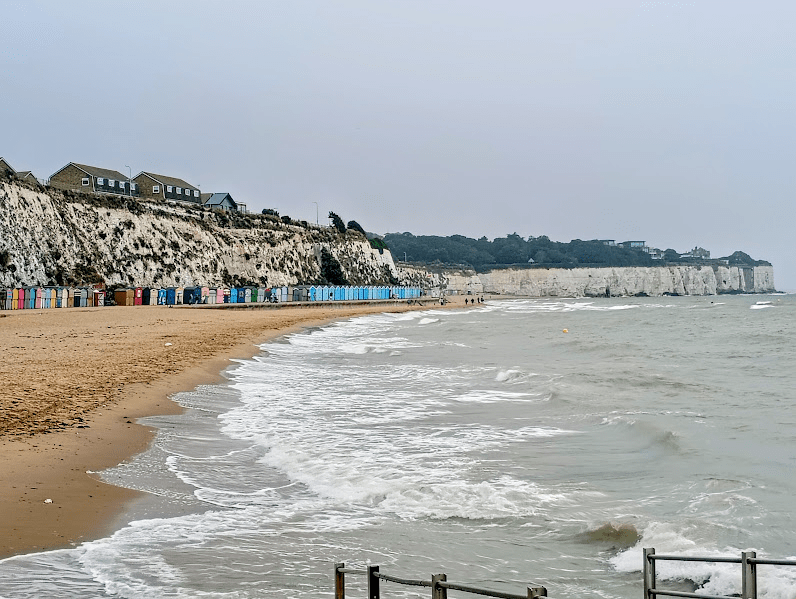
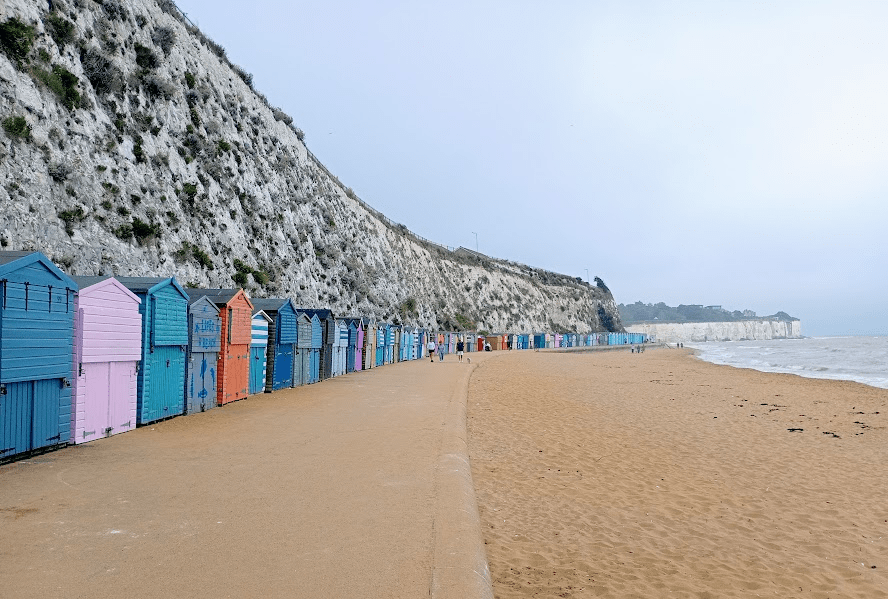
The prom then runs out at the end of the beach huts. I’m not sure whether you would be able to continue along the beach at low tide or whether that section of chalk cliff sticks out too far to allow you to walk around it, but I took the path up some stairs to the road at the top, continuing uphill to the sound of parakeets in the nearby trees. (They love Thanet but we don’t seem to have any in our inland area of East Kent, so it’s always a bit of a novelty, even though I know they are an invasive species.) The path then follows the road onto the private North Foreland Estate which sits along the clifftop. There are some very lovely older houses, as well as some newer glass and steel boxes. They all have enviable views and come with a £1,000,000 + price tag!
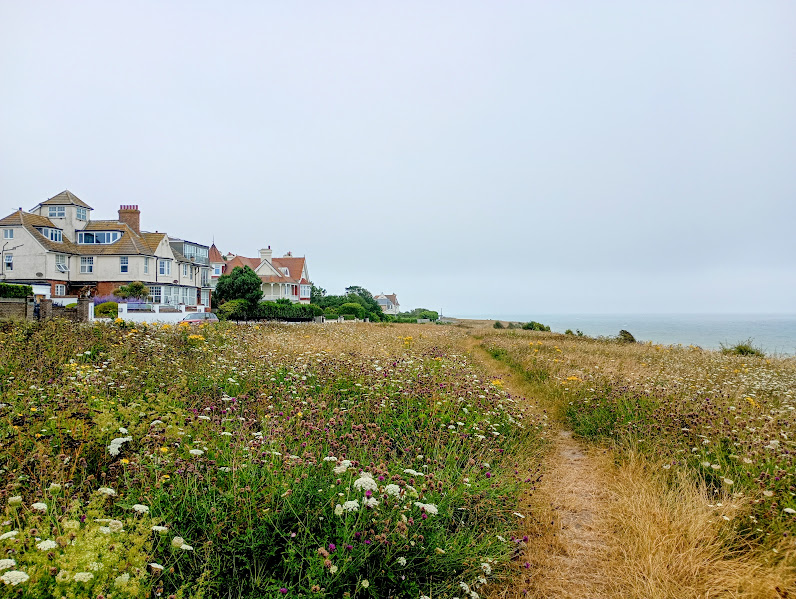
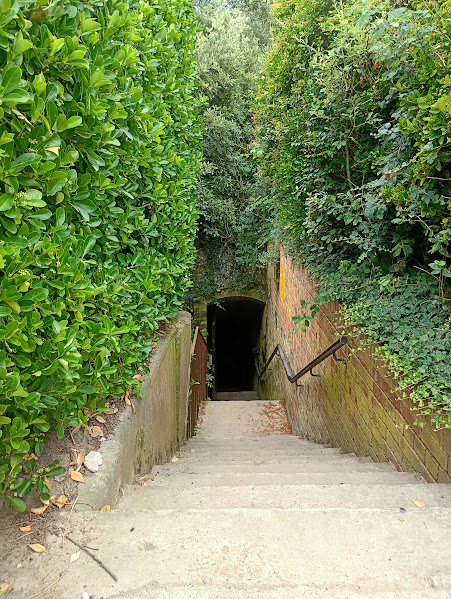
If you look carefully on the cliff edge side of the road, you can find the stairs that were the inspiration for John Buchan’s novel, The Thirty-Nine Steps. (Broadstairs became Bradgate in the book.) Buchan was convalescing at a house on the North Foreland Estate at the time and, although the original steps were wooden, these replacements are basically still the same ones that run from the cliff top down to a private beach and feature (as well as being an ongoing puzzle for Richard Hannay), in the climax of the book. The entrance is well camouflaged by bushes and is fenced off so you can’t walk down, but a well trodden path through the grass will lead you to it and allow you to peer through the railings.
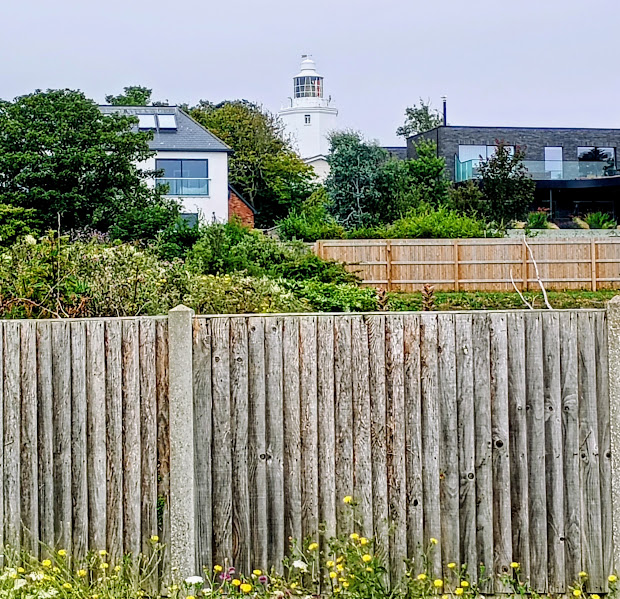
A little further along, the North Foreland Lighthouse came into view, almost hidden behind the houses. There’s been a lighthouse of some form here since 1636, with the current one built in 1691. The houses obviously came along much more recently, but even so, I wondered why the lighthouse had been built so far back, unlike the South Foreland Lighthouse which sits much closer to the sea on the cliffs near Dover.
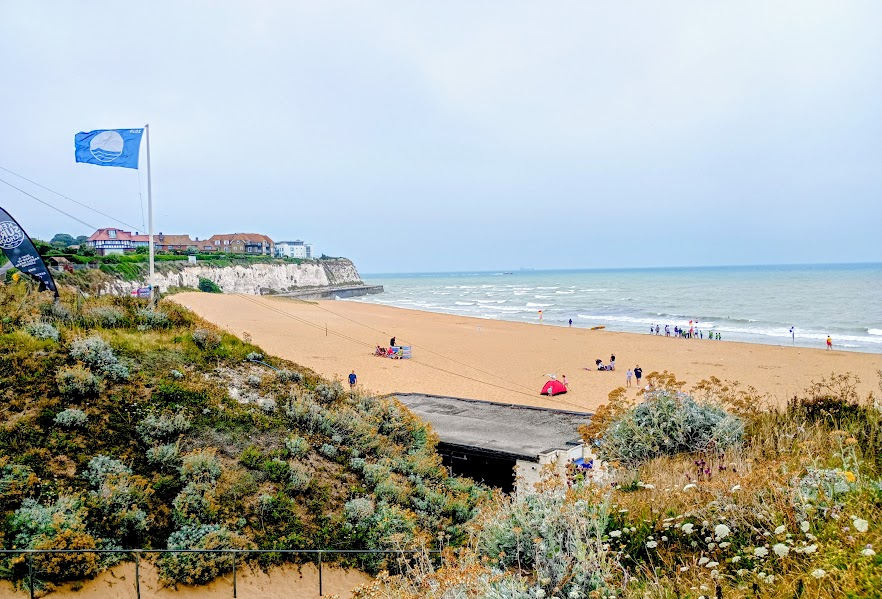
Up ahead is Joss Bay, named after a famous 18th century Thanet smuggler called Joss Snelling – although some stories say that it was him who was named after the bay! Either way, he was so notorious that in later life he was even introduced as a celebrity smuggler to Princess Victoria on one of her visits to the area! Smugglers and shrimp teas. She was living her best Thanet life!
Joss Bay is Thanet’s surfing beach. It has its own surf school. and a group of children were being taught the basics at the waters edge. There are also toilets and a cafe – one of the benefits of walking along the more popular sections of the coastline.
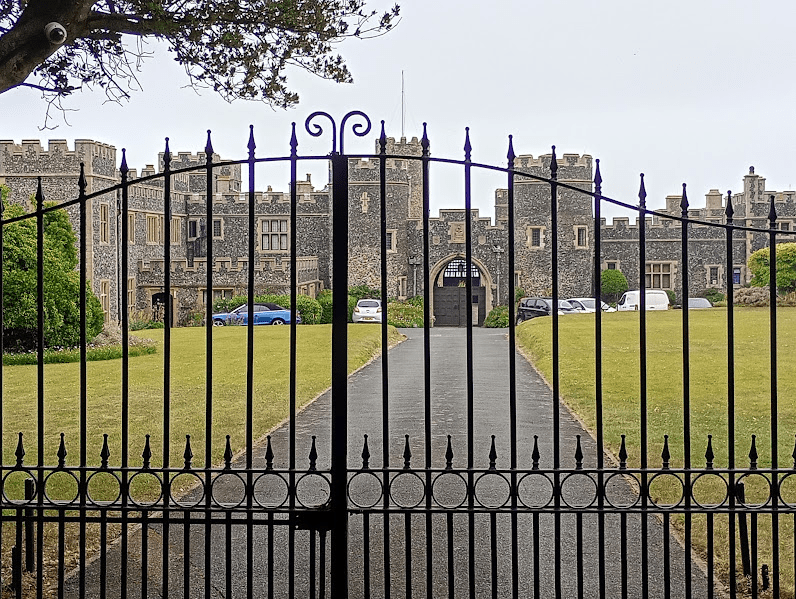
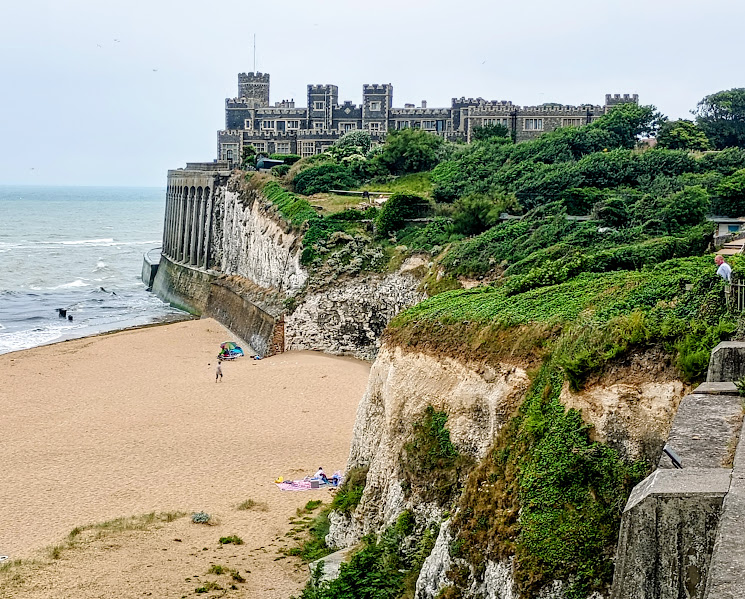
Because of more housing along the clifftop, at this point I had to cross the road and follow a path shared with cyclists and bordering a golf course, but I soon reached Kingsgate Castle which was built in 1760 by Henry Fox, 1st Lord Holland (and Whig politician), to be the stable block for his nearby mansion, Holland House – not to be confused with his London residence, also called Holland House, which was in Kensington (now Holland Park) and which he leased. Kingsgate Castle did fall into a state of repair however, and was subsequently re-built and altered in the late 19th century, so it doesn’t look quite how it would have done then.
And here’s Kingsgate Bay. Apparently it used to be called St Bartholomew’s Gate until King Charles II was forced to land here with his brother, the Duke of York, during a storm in 1683 and demanded that it be re-named in his honour!
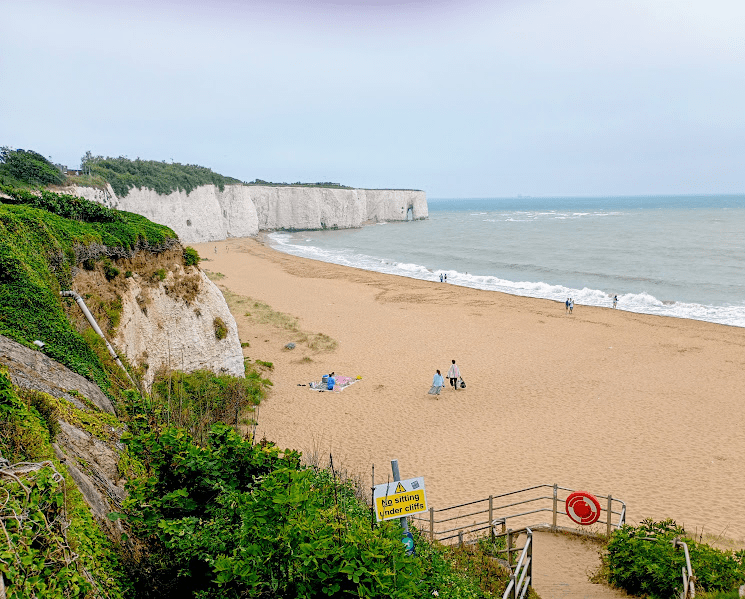
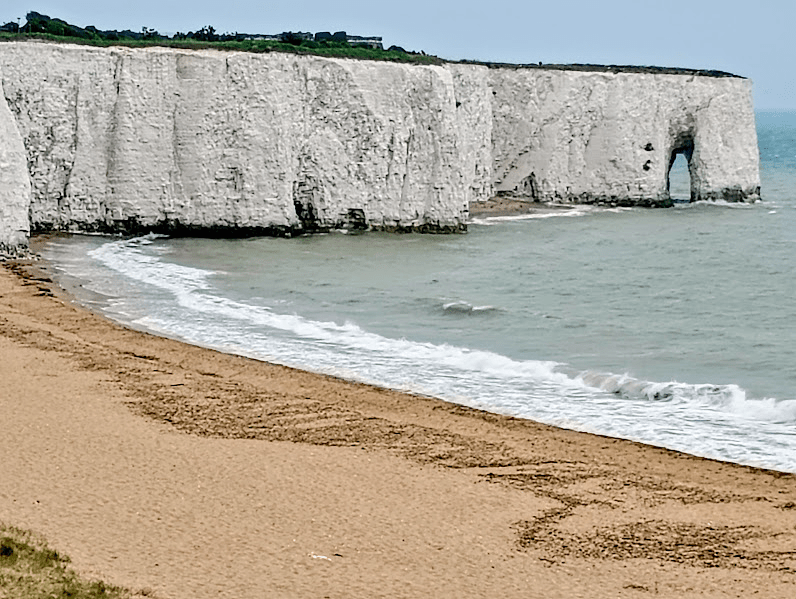
Looking ahead, you can see how tidal erosion has caused an arch to slowly develop in the chalk cliffs,
and looking back, you can see Kingsgate Castle in all its magnificent cliff top glory. The castle has been converted into apartments and, looking online, a two/three bedroom apartment seems to cost about £550,00 which is out of my budget but is probably quite reasonable to live in such an iconic building.
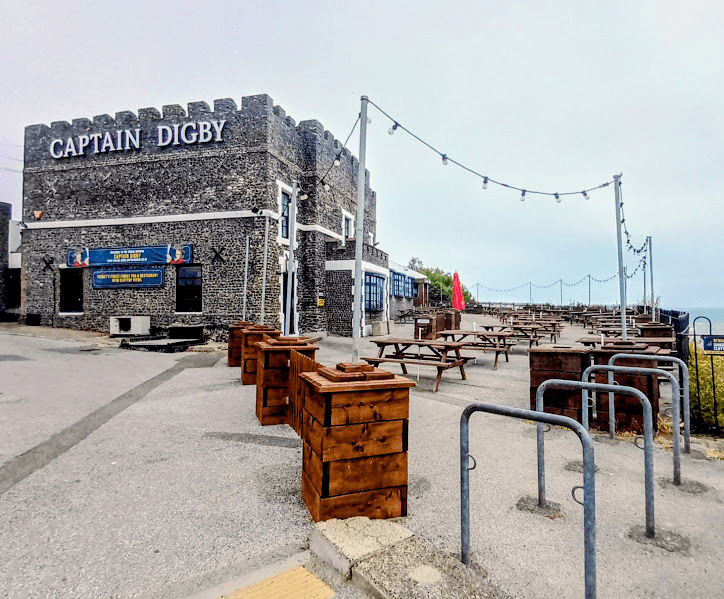
Just down the road is the Captain Digby pub, and its crenellations also make it look like a castle. I had always wondered whether it had been deliberately built to mirror the style of Kingsgate Castle, or whether it was just a coincidence, but it turns out that it had also been built by the same Lord Holland. The house was originally called Bede House and was built as a “House of entertainment …. a bibitory recess for men and horses.” Unfortunately, due to coastal erosion and a severe storm, half of it fell into the sea in 1809, so what you can see now is only a small part of what was originally there. (Captain Digby, in case you are wondering, was Lord Holland’s favourite nephew!) I have never been there, but the prospect of the view from the benches on the terrace always seems tempting. A banner proclaims that this is the best family pub in Thanet, and I wondered how many family pubs there were in Thanet, and therefore whether it has much competition for this self-proclaimed title!
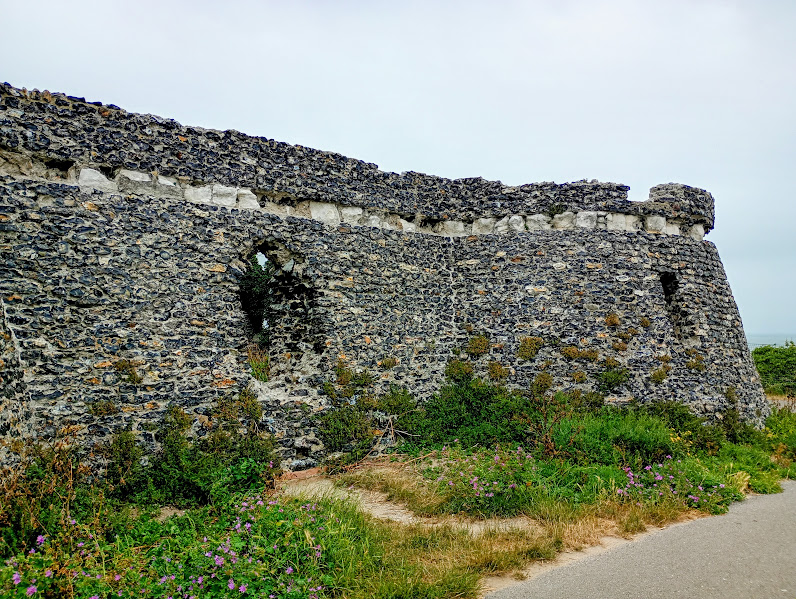
Behind the pub, and adjoining another golf course (or maybe the same one) are the ruins of a castle or fortress, but with no plaque giving any information, I have always wondered what it was doing there and it was time I found out. I suppose I shouldn’t have been surprised, given the similarity in style, that it was also down to the eccentric Lord Holland. He built this one as a folly and called it Neptune Towers. He wanted it to look like a miniature device fort, also known as a Henrican fort, named after the artillery forts built by King Henry VIII along the East Kent coast at Sandgate, Walmer, Deal and Sandown. This man could not stop building castles. I love that for him!
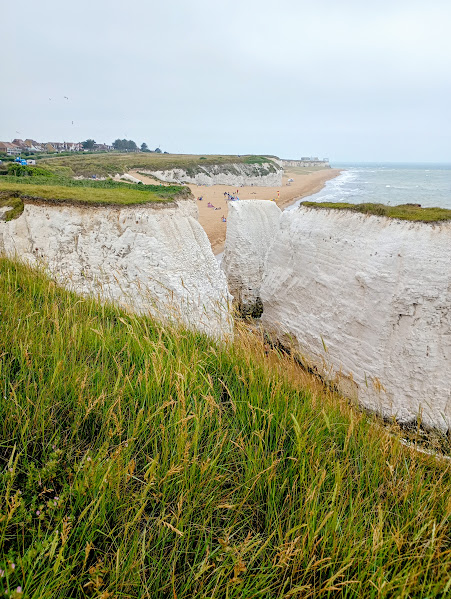
The path continued along the coast to Botany Bay. According to local legend, this one got its name because the bay was a regular landing spot for smuggled goods and the joke was that any smugglers who were caught would be faced with the prospect of transportation to Botany Bay in Australia. It has recently become one of the most popular of Thanet’s bays as a result of social media and its much filmed and photographed chalk stacks – to the point that it can become swamped during the summer, causing lots of problems for the locals. On this slightly overcast July day, the number of beach goers was at a far more reasonable level.
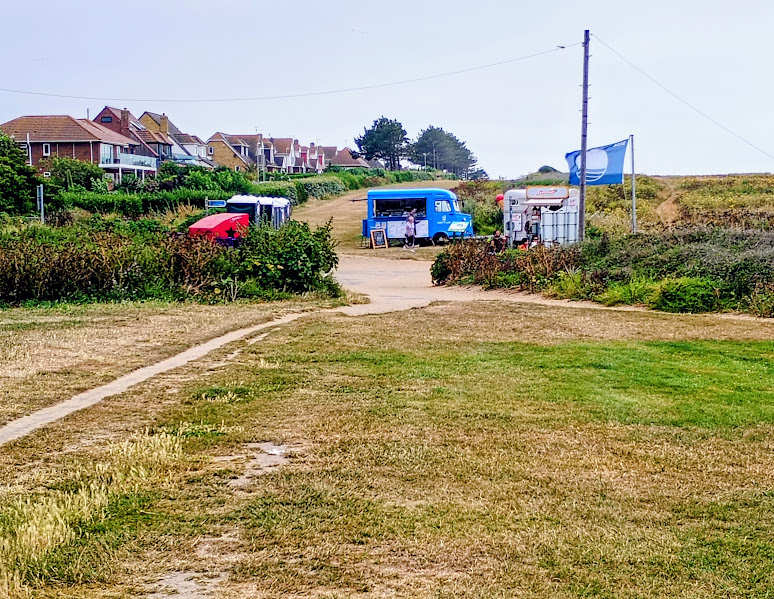
See the little blue van parked up ahead on the cliff top. That was my planned coffee stop (Brew and Bays) at roughly the half way point, and I was ready for it! I always support an independent whenever I can, – for me the coffee chains are only for an emergency at a train station when faced with a delay and needing something to fill the time – and the owner was very lovely, making me an iced mocha even though it wasn’t on the menu. (I have never actually had an iced coffee/mocha before this summer – it’s only in the last year that I have started to like coffee – and now I am addicted and can’t get enough of them!)
I took my drink down on the sands where, when the tide is going out, you can walk between the chalk stacks – though take care to read the notice warning that you can can be cut off when the tide is coming in.
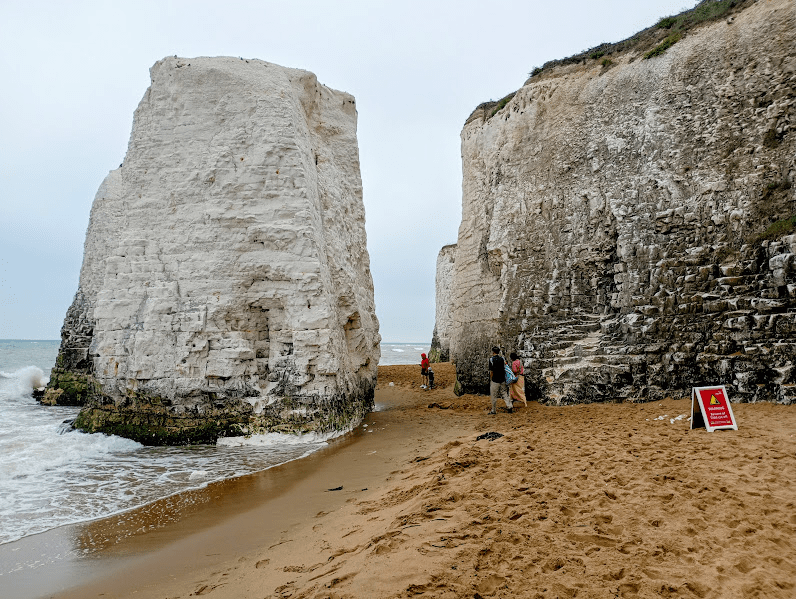
I somehow managed to capture them at a quiet moment, as there was basically a non stop stream of people photographing them, including several who were taking it very seriously, setting up their tripods and posing at different angles.
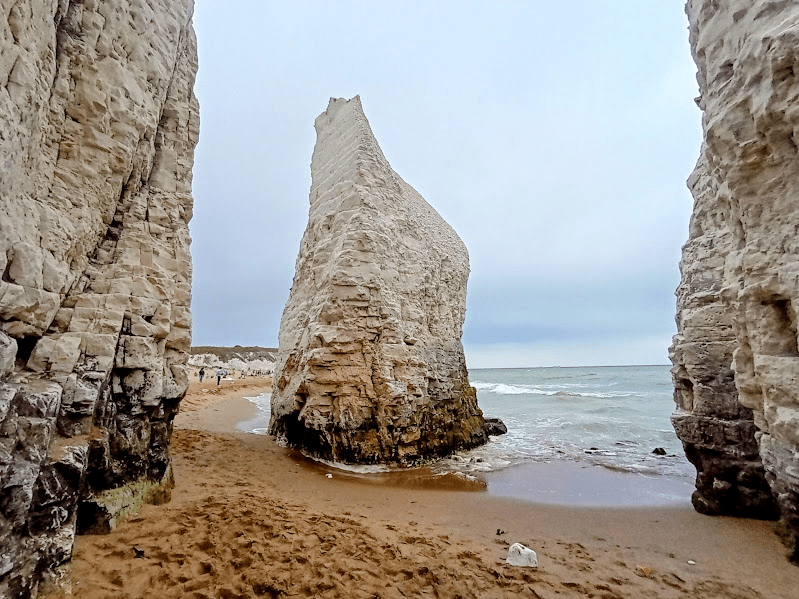
I tucked myself up against the cliff where I wouldn’t be in the way of other peoples photographs and read my book and drank my iced mocha – until it suddenly occurred to me that if the cliffs are eroding then I could get hit on the head by a lump of crumbling chalk and then wouldn’t I look stupid in front of all these visitors. I packed up and headed back to the top of the cliff and sat on a bench up there instead!
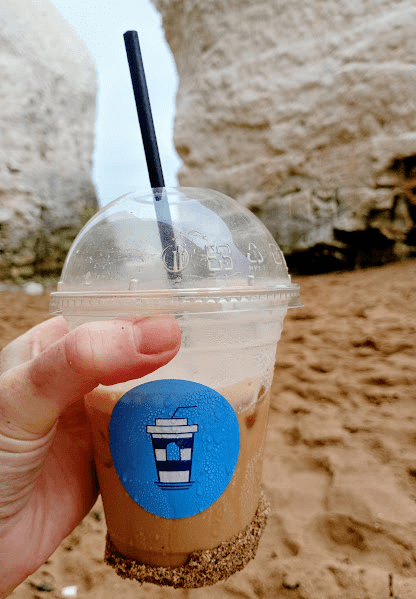
One last look back and on I went.
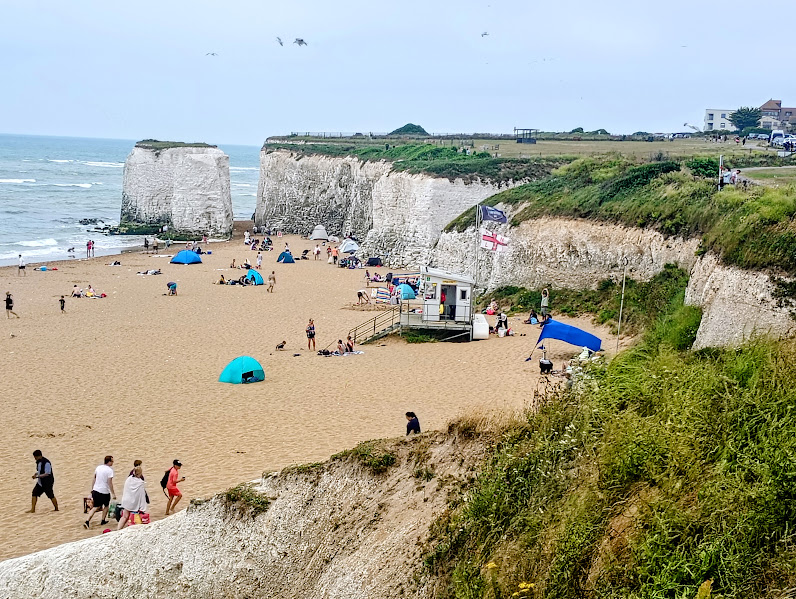
The cliffs weren’t massively high at this point, and with quite a few paths in the grass leading to the edge, I risked a peak – despite my fear of heights. There was a long expanse of beach, with a lot of grass and not so much sand. There were a few people down below and I assume that you get here by walking along from Botany Bay as there was no obvious way down, although it looked as if you could be cut off at high tide here as well. I did read afterwards that this stretch is an unofficial naturist beach, which makes sense given its slightly out of the way position, and something to be aware of if you are taking a stroll.
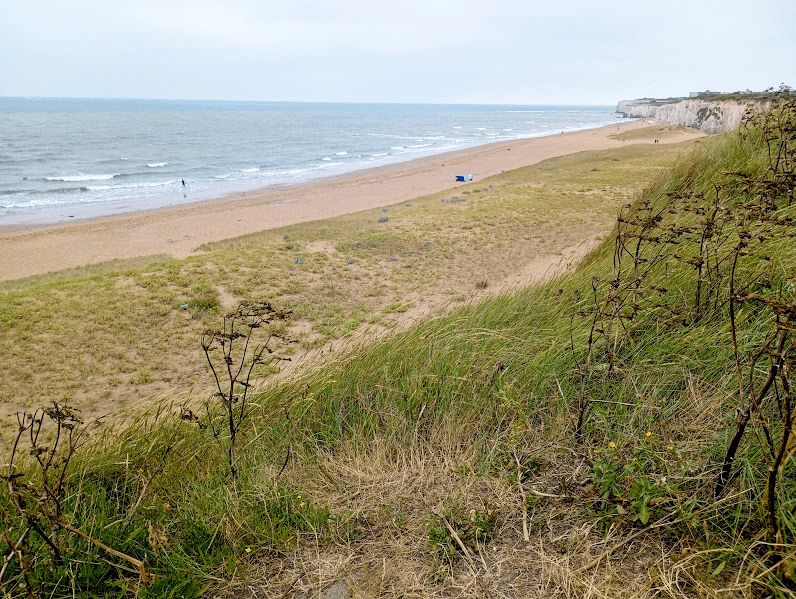
I think this was part of Foreness Point – a low headland that juts out and marks the start of the Thames Estuary and is also the point at which you kind of turn a corner and start heading along the North Kent Coast, so quite a significant moment for me and my coastal walk! Here, just past the waste water pumping station), I investigated a steeply sloping path down to the beach and found myself on the promenade once again – for a short distance at least. According to the map this was Palm Bay, although there was a notice that said it was Foreness Bay. I think they are one and the same really, with the latter only distinguishable by the fact that it has a jet ski club, and that part of the bay is an official water sports zone. You couldn’t see much of it, but it was my least favourite of all the bays.
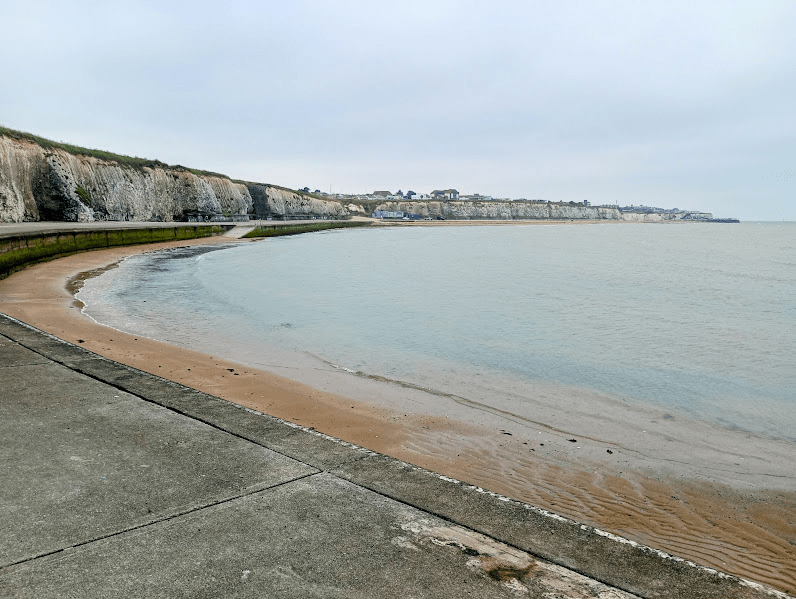
So, if that first section was Foreness Bay, then this is Palm Bay proper. The raised promenade became a sand level promenade – although you could see the way that the sand has gradually shifted up the beach. No need for those steps any more!
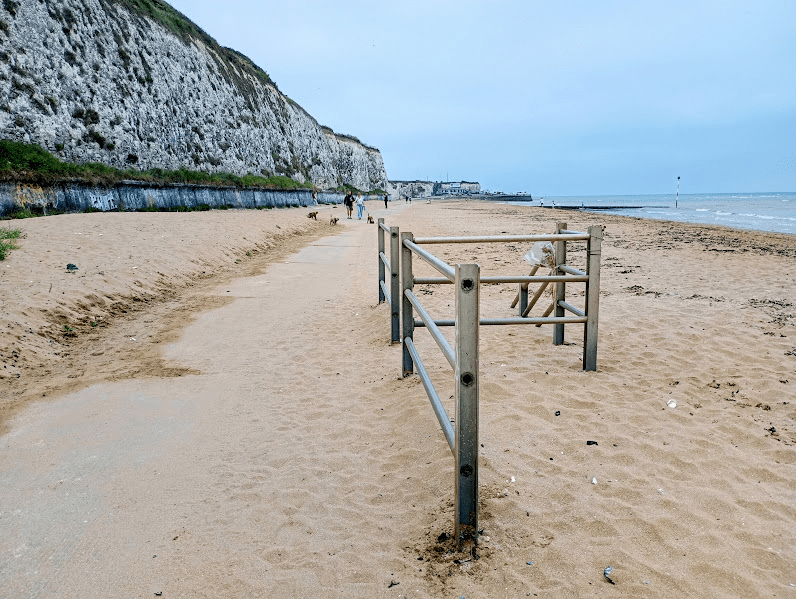
Where another steep slope came down to the beach, the promenade ran out completely and I walked across the sand,
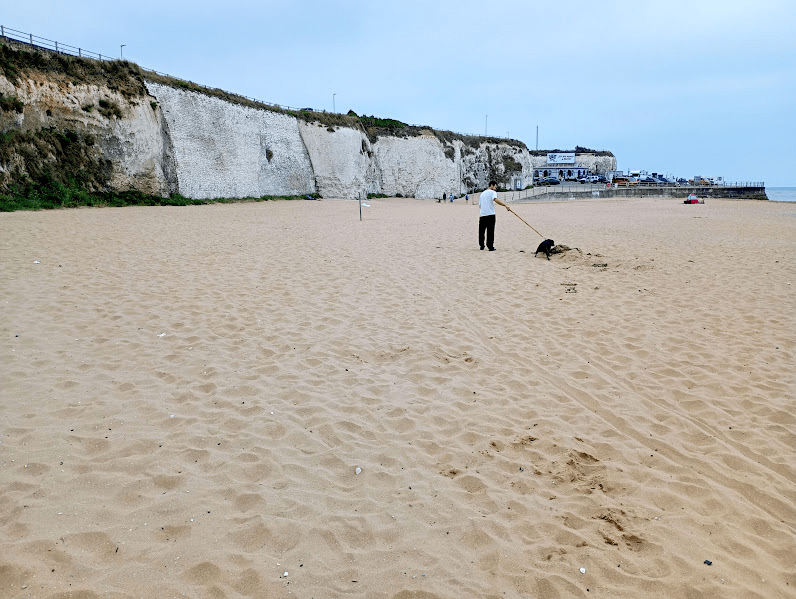
with a last look back across Palm Bay to Foreness Point,
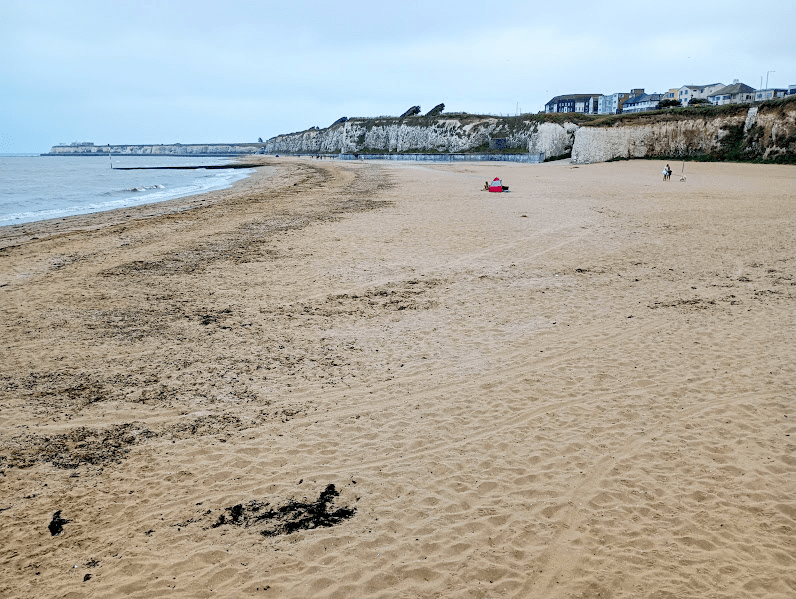
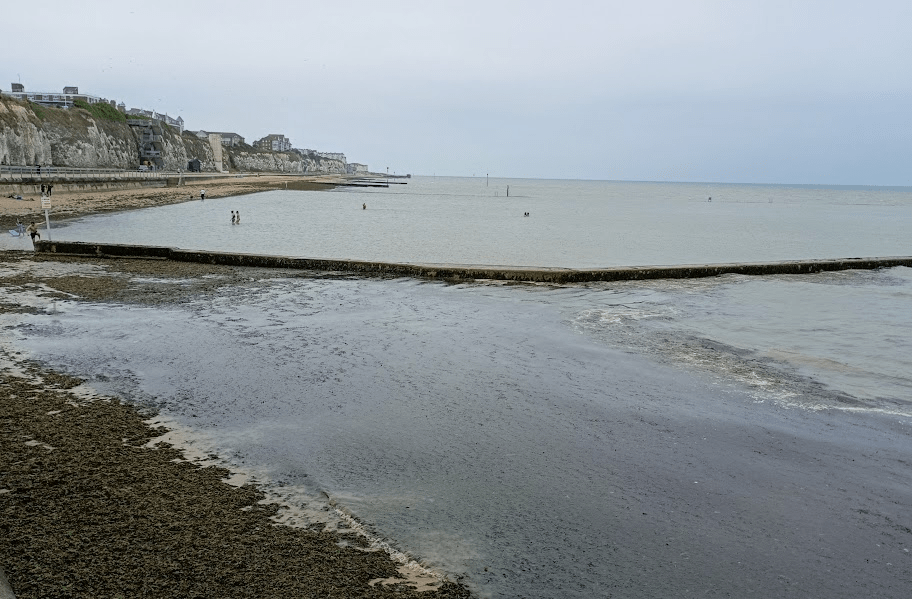
and headed round the edge of a car park full of camper vans, and into Walpole Bay. There’s a popular tidal swimming pool here (though seemingly not so popular when I was there),
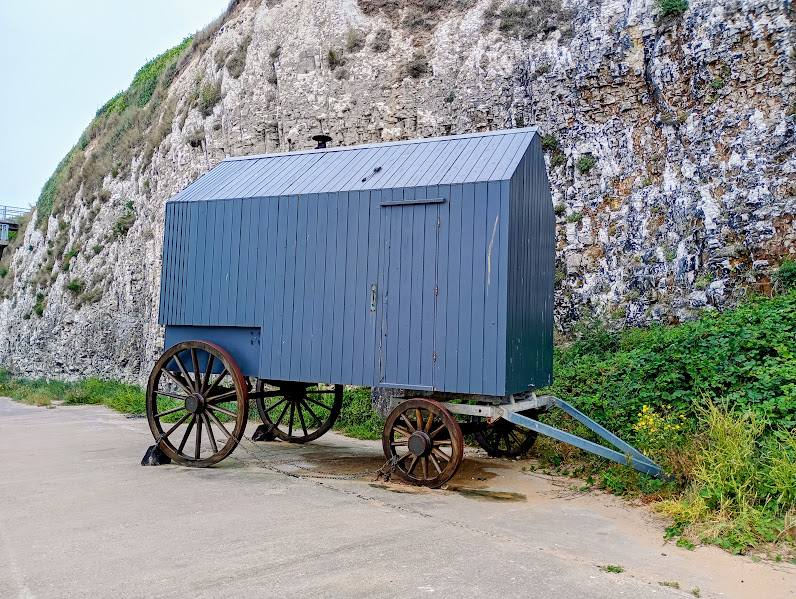
as well as a community sauna, designed to look like an old fashioned bathing machine, which is free to use. I’m not really a sauna person, but judging by the popularity of the ones that are popping up all along the Kent coast, I am probably in the minority. This one appeals to the old fashioned seaside lover in me though.
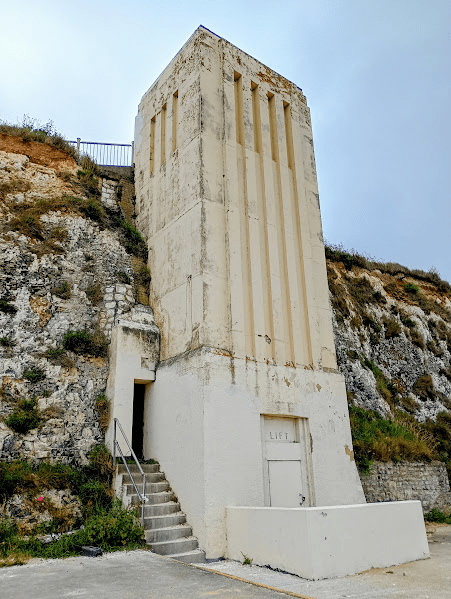
I then came across another abandoned art deco style cliff lift. Apparently it was built by the Ministry of Health in 1934 to encourage people to use the beach. I am positively evangelical about the mental health benefits of walking by the sea and would be all for such initiatives to be put into place today. Get the lifts restored and get people embracing the sea air once again!
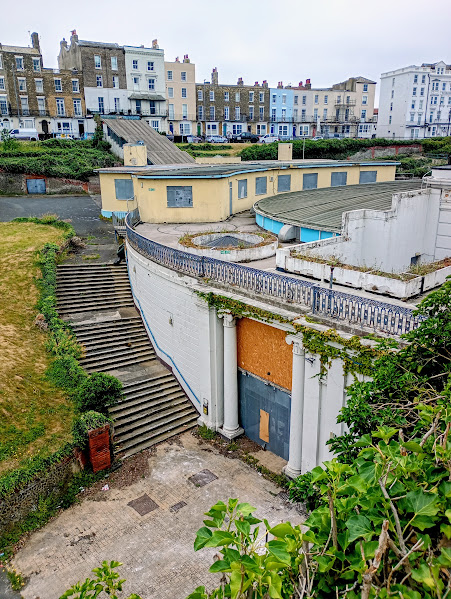
You can tell that I’m getting close to Margate now, with the disused and abandoned Cliftonville Lido up ahead.
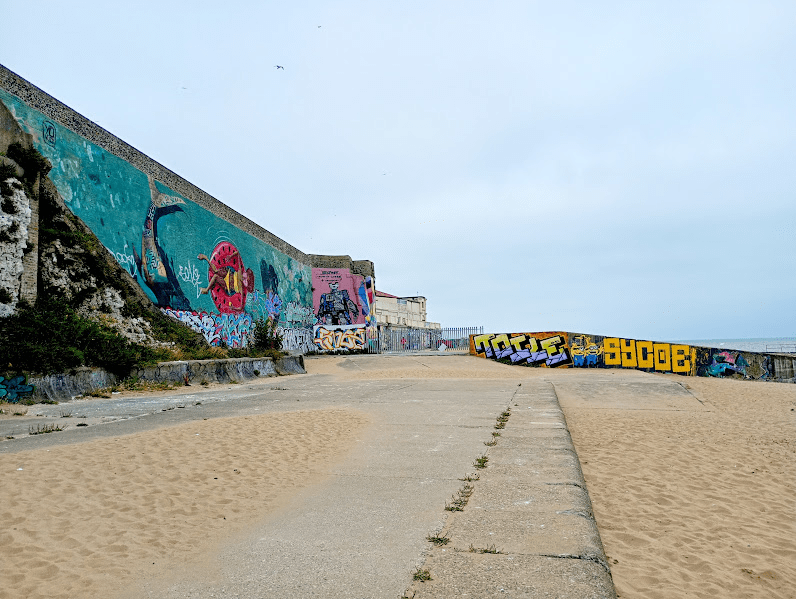
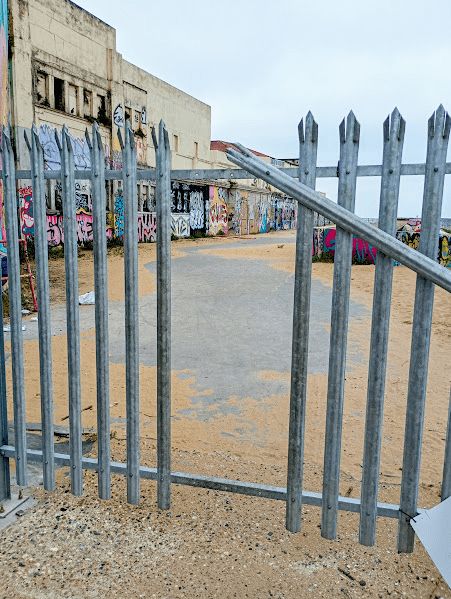
Hmm. The path was blocked by a fence, but a section of railing had been pushed aside to allow a person to squeeze through. It was looking pretty deserted ahead, but I had passed other people who had come from this direction. Had they come through the gap from Margate, or had they turned around when they found their way blocked? I didn’t really want to re-trace my steps to find a way around it, and as I ducked and went through, I thought of Theresa May who once said that the naughtiest thing she had ever done was to run through fields of wheat. As a very law abiding citizen, this small act of trespass was probably one of my naughtiest!
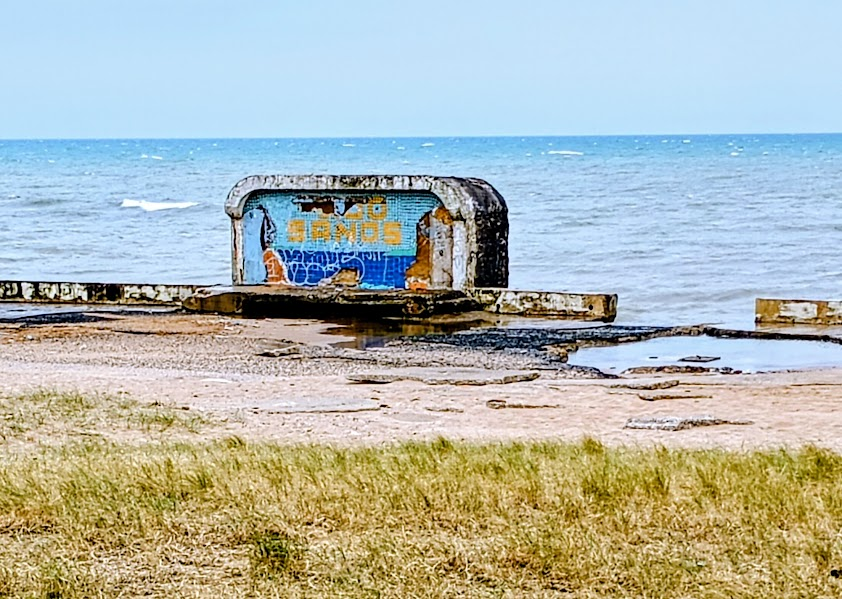
The lido was originally built as Clifton Baths in 1824, in order to capitalise on the Georgians love of sea bathing. It was then turned into a lido in 1926, and remained a popular part of Margate’s tourism industry until the 1980s when it was finally closed. The only evidence of its former heydey that I could see was the mosaic sign, just about still readable, and worthy of preservation.
I was glad to have seen it but was a little bit nervous about being confronted by a security guard, and I also realised that there seemed to be another fence ahead blocking my way out. I was going to look very foolish if I couldn’t get out again, and my trespassing would be clearly displayed to those on the other side. Being naughty really doesn’t suit me! Thankfully, there was a gap around the edge and so I was able to slip through and make my escape.
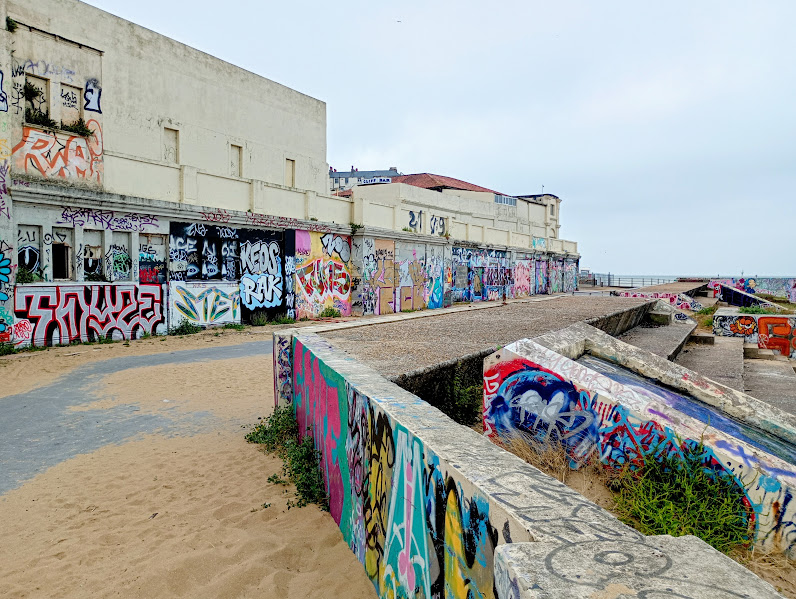
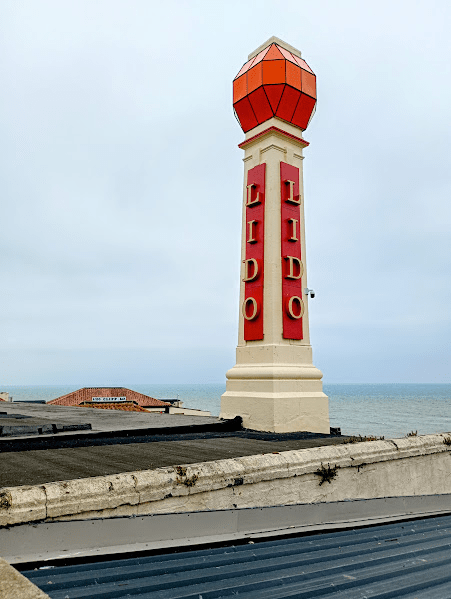
I was flagging by this point, but decided that I would foolishly increase my step count by heading up top to see what the lido looked like from there. I was glad I did, as I got to see a fabulous sign – in great condition – still proclaiming its former life, although from looking at it you would think it was still operational. Why couldn’t the lovely mosaic have been preserved like this? Also, I haven’t been to Cliftonville before, but the small stretch I could see across the road, with some interesting looking shops made me think that I would like to explore further – when I haven’t just walked from Broadstairs that is! Interestingly, Northwood Road in Cliftonville has recently been named one of the coolest streets in the world by Time Out Magazine, so on that basis, and with my love of independent shops and cafes, I need to get myself down there.
And here comes the third derelict building/structure in a row – the Winter Gardens, formerly Margate’s premier entertainment venue. Closed since 2022, and looking very sorry for itself, I was pleased to discover that it is supposed to be undergoing restoration – although there was no sign of it – and that it may be open against next year. Re-generating the Old Town is all well and good, but I strongly believe that the restoration of such a venue is hugely important for the local community.
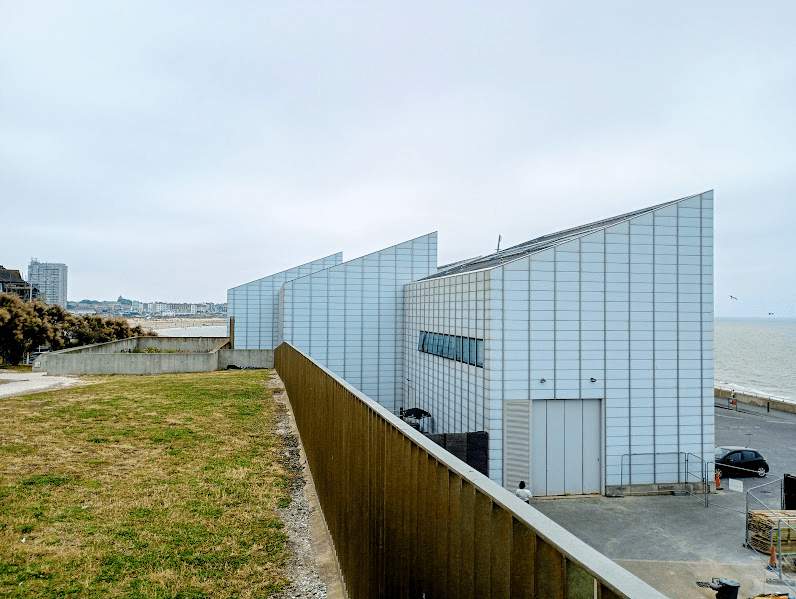
Soon after, the Turner Contemporary Gallery came into view. I love a gallery, but am not a fan of contemporary art – I just don’t understand it. I rarely go into the Turner, but am not ashamed to say that I went in purely to use the toilets.
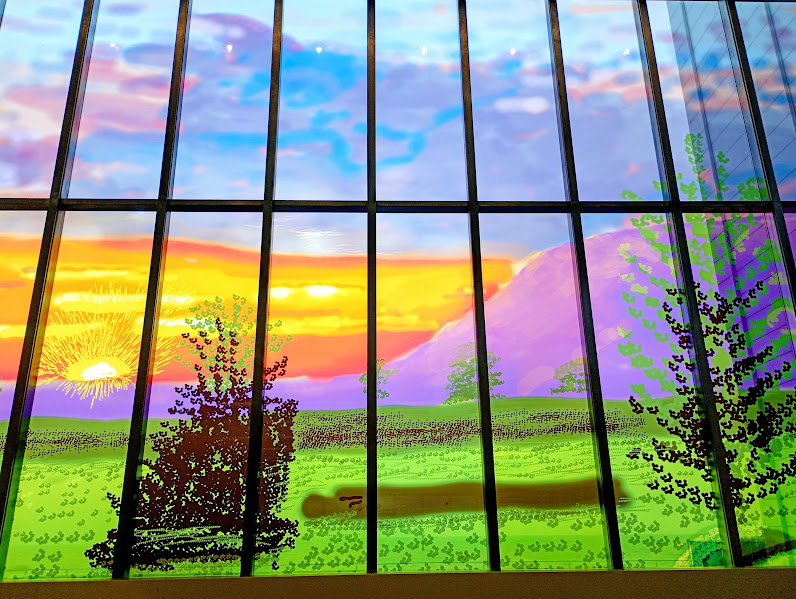
However, in the entrance hall I was met with this wonderful window. It was called the Sunley Window – a glorious sunrise, which had been created by David Hockney, inspired by his time living in Normandy, and which had been commissioned for the 15th anniversary of the Turner Contemporary’s opening. I loved it and was very glad that I’d needed a wee! I might even go back for another look while it’s still there!
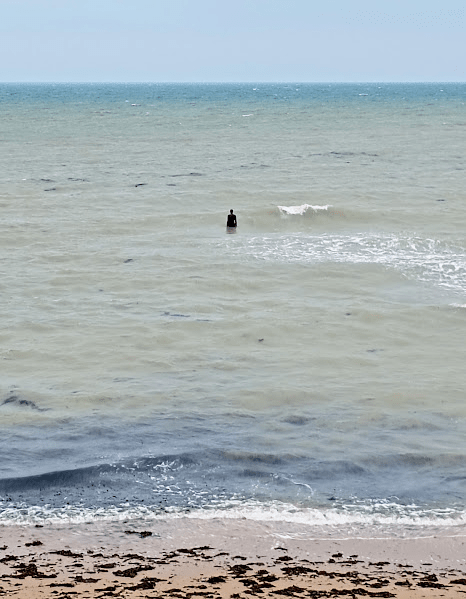
Outside I had a quick peek over the sea wall at the Anthony Gormley statue, just coming into view as the tide went out
and then walked along the harbour arm to the lighthouse at the end
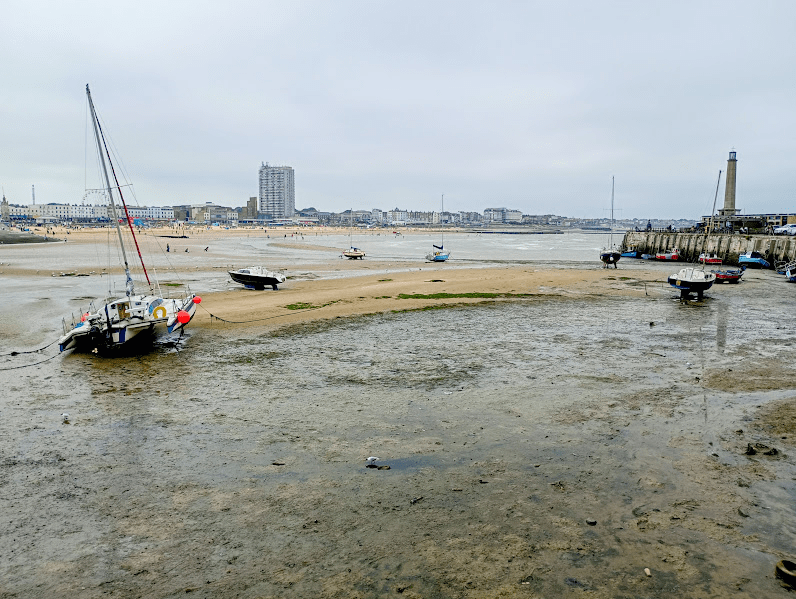
to see the statue of the Shell Lady – a tribute to twice widowed Sophie Booth, Margate landlady and lover/partner of the artist JMW Turner. Her guest house was on the seafront site where the Turner Contemporary now stands, and the two of them were known as Mr and Mrs Booth.
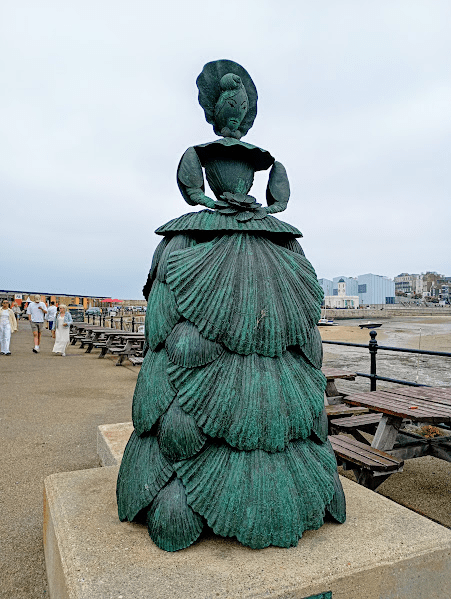
(The view from the Harbour Arm across Margate’s Main Sands.)
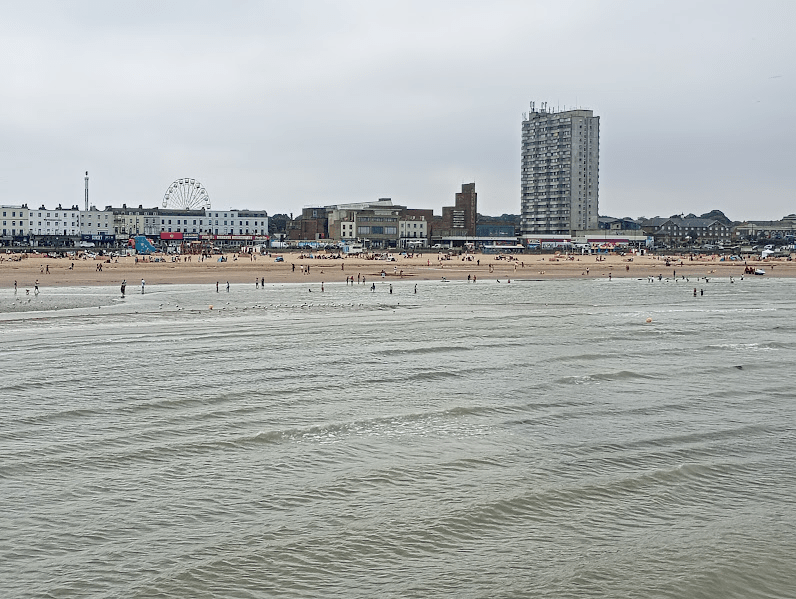
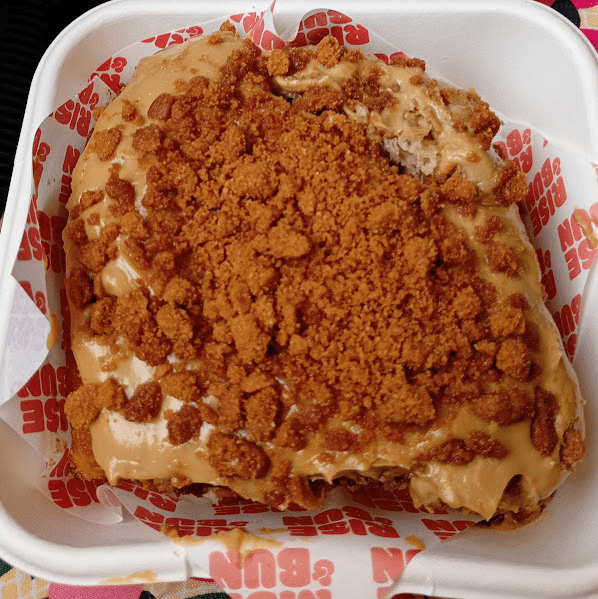
From there I popped into the Old Town in search of a Chelsea bun. I have mixed feelings about things that go viral on social media. Do I want to be the kind of person who queues up for something because instagram tells me that it’s good? Not really, but the Chelsea buns at Rise and Bun did look very good! The last time we were in Margate, the shop, which only sells Chelsea buns, had not long been open. There was a very lengthy queue and they were definitely going to have sold out before all those waiting could be served, so we didn’t bother joining. Today, there was no queue at all and there were full trays of the sweet treats in the window. There were so many flavours to choose from, but I settled for a biscoff one.
I sat on the steps that run along the side of the beach with my lunch (goodness, wasn’t I organised today!) feeling very content – at which point my day ended on a sour note.
I opened the bun box just to have a look – I wasn’t even going to eat it until later – and I was instantly dive bombed by a seagull. It’s never happened to me before, and I have only ever seen it happen to other people a couple of times, so I suppose that despite all the seagull horror stories you hear, I was a bit complacent. It didn’t actually take it. It swooped, I slammed down the lid and it was gone. Too scared to open it again while I was still on the beach, I assessed for potential damage on the train home, trying to work out whether the disturbed frosting was where it had stuck its beak in, or whether it had just got a bit shaken about in my bag. I hate food waste, have a healthy disregard for best before dates, and happily use up fruit and veg that is no longer looking its best as long as it smells ok. Could I just cut it in half and eat the half that was definitely undisturbed? I looked online. “Don’t eat food that a seagull’s beak has touched” warned all the advice. “They carry E coli, salmonella and worse…….don’t cut off the affected part…..bacteria can quickly spread throughout the food.” I messaged my daughter, who was inter-railing around Europe and who has a similar food outlook to me, to see what she thought. “THROW IT AWAY!” she instantly messaged back. “BIRD FLU!! We have too much planned for the summer for you to be ill.” It went in the bin and I was very sad – but didn’t it look lovely!
Read my Kent Coast Walk Part 10: Ramsgate to Broadstairs here.
Read my Kent Coast Walk Part 12: Margate to Birchington-on-Sea here.
 A Little Kentish Magic
Leave a comment