
Augustine was a 6th century monk, who in 595 was sent by Pope Gregory, along with a band of 40 other monks, to bring Christianity to England. He got as far as Southern Gaul before tales of the ferocity of the Anglo Saxons and the perils of the English Channel saw him turn and return to Rome. Gregory encouraged him to continue with his mission however, and so he set out again, this time landing near Ramsgate in 597. It is thought that he came to Kent because although King Aethelberht (the King of Kent) was a pagan, his wife, Bertha (a Frankish princess) was already a Christian.
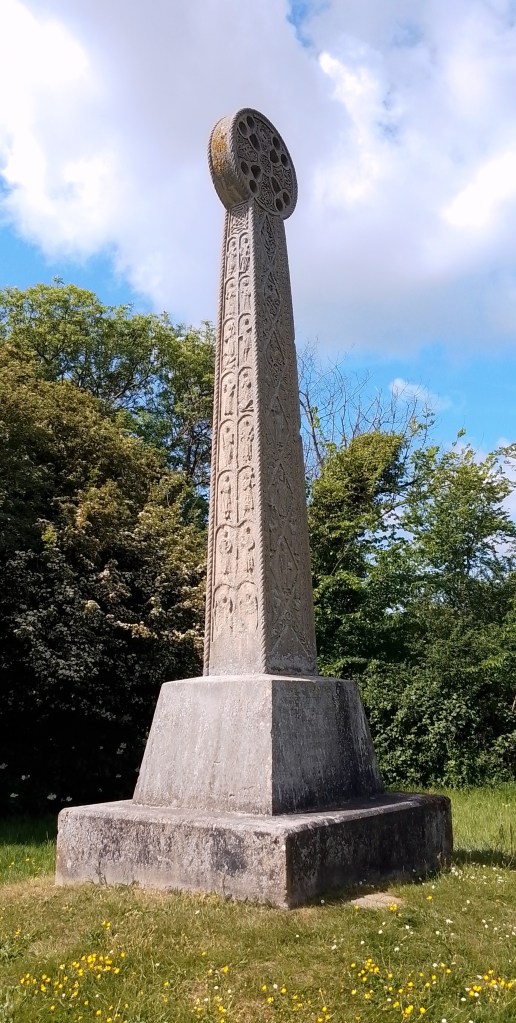
According to the Venerable Bede, a 7/8th century monk and historian, he was met here by King Aethelberht (although he was writing about it over 100 years later!) and, despite being wary of these new arrivals and concerned that they might be practising sorcery, the king allowed them to preach. A cross (put up in the 19th century and owned by English Heritage), now marks the site where he is thought to have landed and had this first meeting.
King Aethelberht allowed Augustine and his monks to settle in Canterbury, and they initially preached from St Martin’s Church. This is the oldest church in continuous use in the English speaking world, and was originally built during the Roman occupation, but was restored by Aethelberht following his marriage to Bertha in 580, so that she could pray there. Within a year of his arrival, he had converted ten thousand people, including the king himself, and not only had he founded his own church on the site of what is now Canterbury Cathedral, but the King also gave him some land outside the city where he established the monastery of St Peter’s and St Paul’s (later renamed as St Augustine’s Abbey). Augustine was ordained as the very first Archbishop of Canterbury, and laid the foundations for the spread of Christianity throughout the country.
St Augustine’s Day is celebrated on 26th May in the UK (the date of his death) but for some reason his saint’s day is marked on either the 27th or 28th elsewhere. If I was the leader of Kent County Council, I would declare it to be a Kentish bank holiday (although this year it did actually coincide with a national bank holiday), but as it is, the day goes by relatively unnoticed. I’m sure that in the past the flag of St Augustine (black with a white cross and a gold pallium) has been flown from Westgate Towers in Canterbury, but today there was just a union flag as usual.
We chose to celebrate the day by going on a mini Augstine Camino, beginning at the Augustine Cross – a short walk across a field from Thanet Parkway train station. Visiting the cross is one of the things that I have previously only glimpsed from a train window, is one of the things that I was hoping to do this year, so that’s now ticked off!
From there we walked into Cliffsend, stopping for a quick drink at Njord Cafe/Bar, where we perched on stools in the window, admiring the view across Pegwell Bay, before following the Way of St Augustine, part of the 19 mile footpath which runs all the way from Canterbury – or strictly speaking to Canterbury, if you are following in the footsteps of the man himself.
The path passes the Hugin viking ship, a replica longship which actually sailed from Denmark to Thanet in 1949 to commemorate the 1500th anniversary of the landing of Hengist and Horsa, chieftains from Jutland, who led the first bands of Saxons who settled in Britain. It’s an impressive sight and makes you realise how terrified the poor locals must have felt as they saw the dragon’s head approaching.

We continued walking towards Ramsgate, turning off to visit the church and shrine of St Augustine built by Augustus Pugin, the architect who also designed the Houses of Parliament. Pugin had fond childhood memories of Ramsgate from when he visited his Aunt, and as an adult he decided to build himself a house, The Grange, which you can see on the left in the photo below.
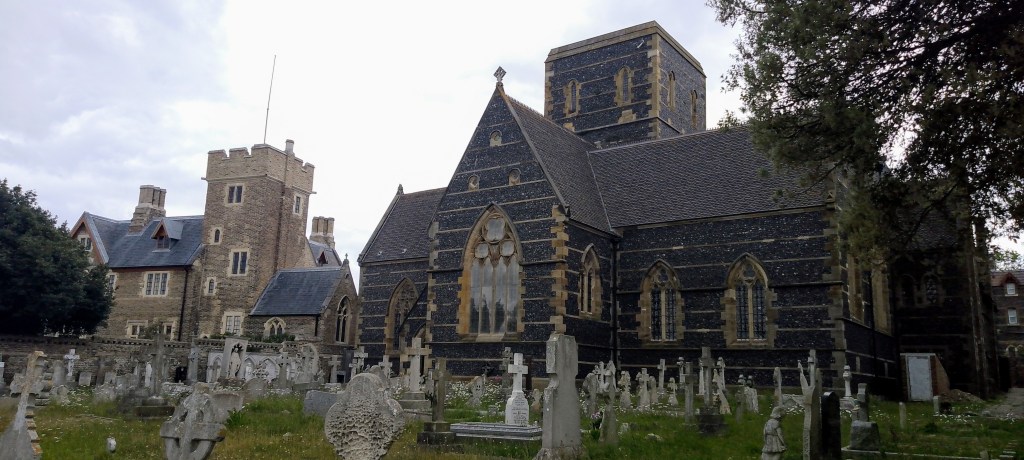
Once the house was finished, he set about building a church next door, which he designed and paid for himself, and dedicated to St Augustine, his patronal namesake. It is a fabulous example of the Gothic Revival style that he favoured, and as we walked around it was difficult to believe that it was only consecrated in 1850. Unfortunately Pugin died, age 40, in 1852 before he had time to build the tower to the full height that he had envisaged, or to add the steeple that he dreamed off, although three of his children were also architects and carried on some of his work after his death.
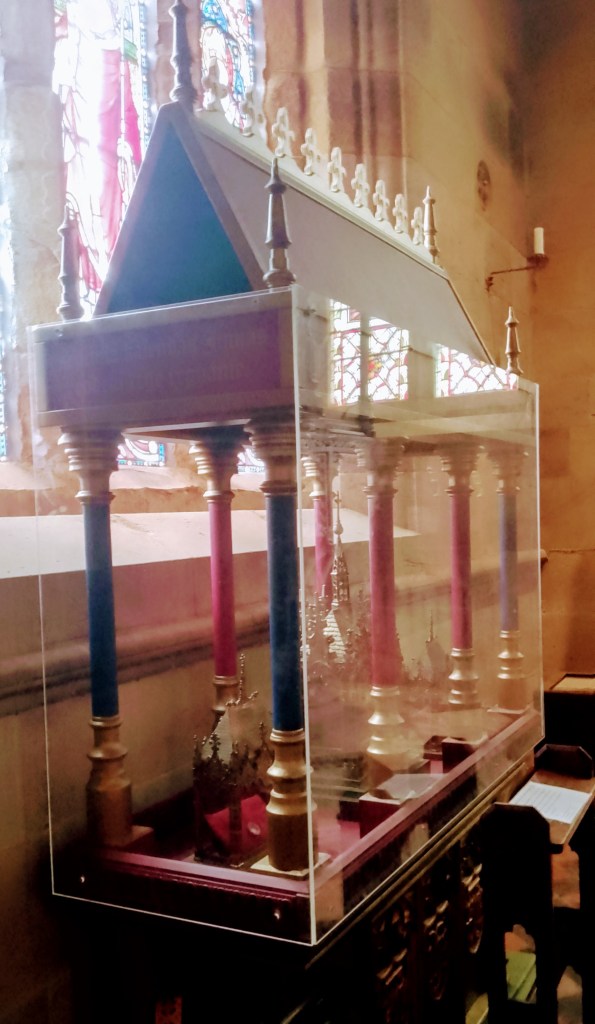
St Augustine’s original shrine in Canterbury was, like so many others, destroyed during the reformation, on the orders of Henry VIII and whilst most of his remains were destroyed too, some parts were taken elsewhere for safe keeping. In 2012, a small piece of bone was donated to the church and it formally became the official Shrine of St Augustine of England.
There was a beautiful stained glass window depicting scenes from the life of St Augustine,

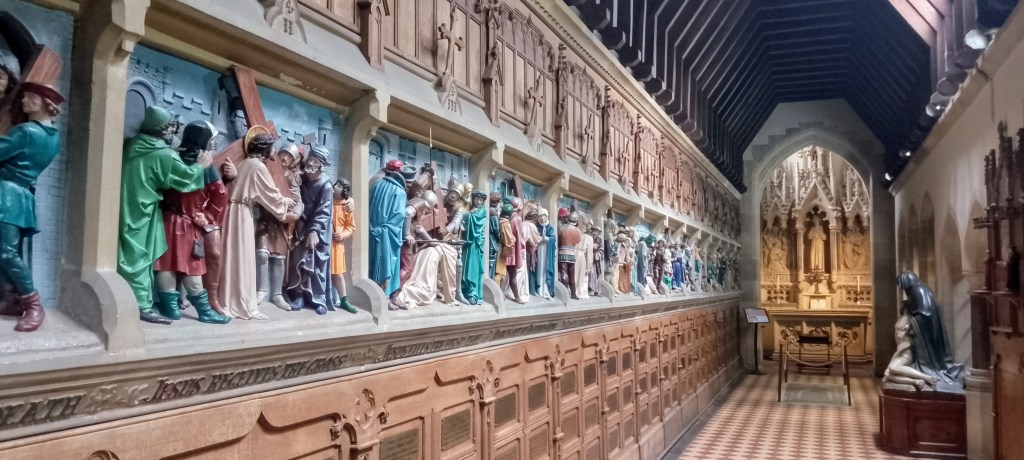
and although it had nothing to do with St Augustine, I was completely bowled over by the cloisters with these incredible vibrantly painted terracotta figures of the stations of the cross which ran along the entire length.
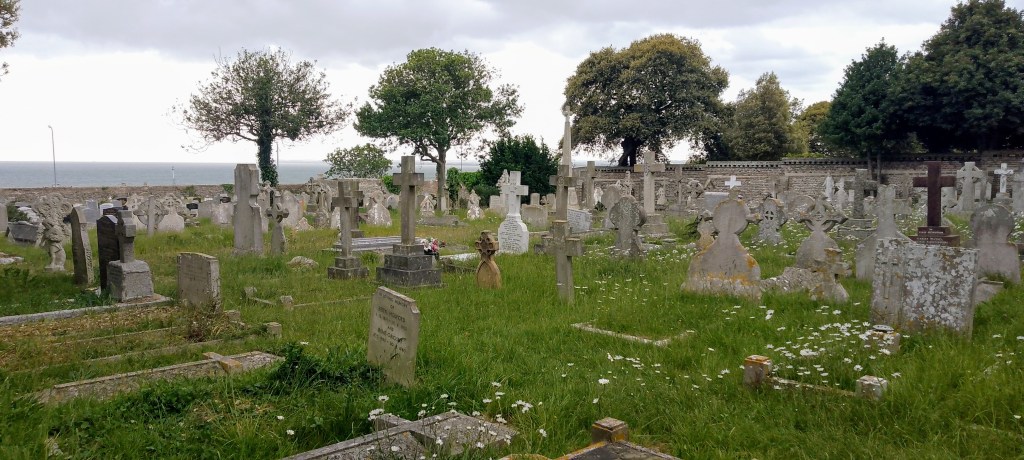
We had a quick look in the church yard, with its view out to sea, before toiling up to Ramsgate train station which is quite a way from the coast. It had been the longest and most exciting walk I have managed to do so far this year, taking in two new sights, and coming in at a little over 12,000 steps, including the walk to and from our house to the train station. Not that much in the grand scheme of things, or compared to what I was walking pre-relapse, but quite the achievement for me. And even though I could barely put one foot in front of the other for the last leg and felt fairly horrendous afterwards, it felt as if another corner had been turned.
Back at home, we continued to celebrate the day by enjoying some local recipes and products, one of these being the Kentish huffkin. This is a white roll with a dimple in the top, which was apparently created by a farmer’s wife for the cherry pickers on her farm, and the dimple, created by her thumbprint, was for holding a cherry. (Incidentally, it was Henry VIII who ordered the planting of the cherry orchards around Faversham, having acquired a taste for the fruit whilst in France, and so it is thanks to him that the huffkin exists.)

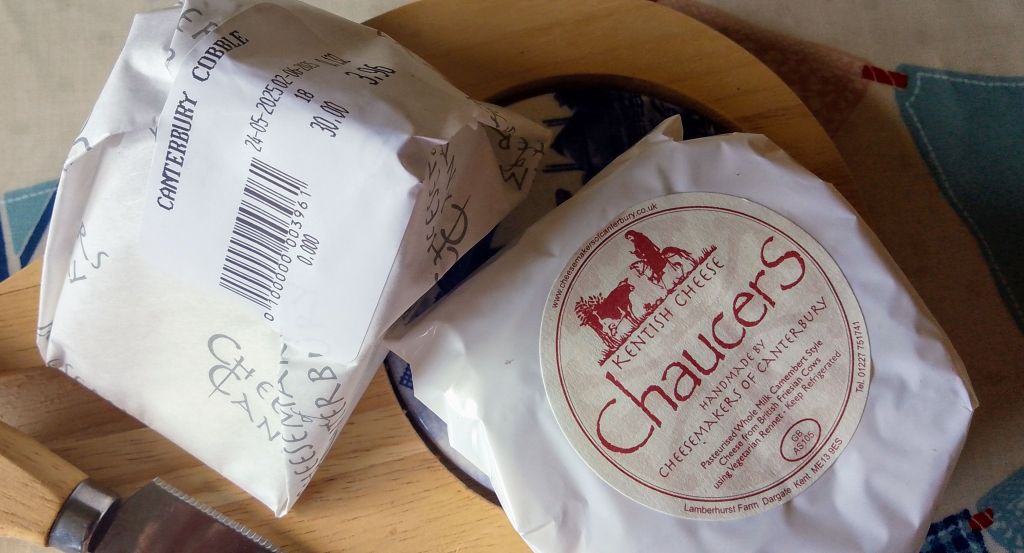
My huffkins were a bit misshapen, and we didn’t have a cherry on the top as Kent cherry season hasn’t yet started, but we did eat instead we ate them with some local Kent cheese. I love cheese. All cheese, although the stronger or bluer the better! It is my very favourite food and the reason why I could never take one step further to become vegan. I normally only have supermarket cheese because of my budget, but in search of something more locally produced, yesterday we had headed to the Goods Shed – a farmers market/food hall, housed in, you’ve guessed it, an old railway goods shed – by Canterbury West Station. Oh my goodness it was delicious. Especially the Chaucer camenbert style one. I will have to start saving up to go back!
I had also baked a batch of ‘plump pilgrims’, which I assumed was a local thing as they are sold at Tiny Tim’s Tearoom in Canterbury, along with huffkins. When I came to research recipes however, I could find no mention of them, and google kept referring me to recipes for ‘fat rascals’ instead. The fat rascal is a Yorkshire classic, a kind of cross between a fruity scone and a rock cake, so I assume that Tiny Tim’s have adapted this and referenced the pilgrims to the shrine of Thomas Becket at Canterbury Cathedral to make it their own. The fat rascal version traditionally has two glace cherry eyes and a grinning mouth of almonds, which presumably makes them look more rascally. With the exception of Chaucer’s Wife of Bath and the Miller, I am sure that pilgrims heading to Canterbury were a more sedate bunch, so I decorated mine, like Tiny Tim’s, with a single cherry on top. They are delicious, and I am happy to adopt this variation as a Kent classic!

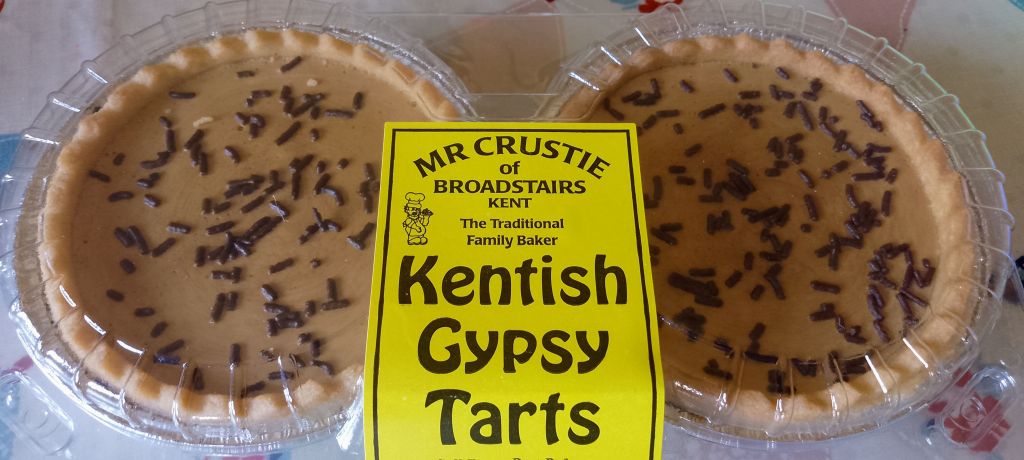
Something that is undoubtedly a Kent classic is gypsy tart, a school dinner favourite for those of us of a certain age. It is basically whipped evaporated milk and brown sugar, baked in a pastry case, and is tooth achingly sweet. I can only eat a tiny slice, but it is delicious and the nostalgia is real! I had intended trying to make my own, but the recipe reviews were variable and as I had previously discovered that Morrsions stocked some that were produced by a (fairly) local bakery, and I noticed that they didn’t have an ingredients list as long as your arm, decided to take the easy option.
To accompany the local food, we also managed to pick up some local drink – cherry juice, and some Kentish Pip cider, which is made on a farm in the village of Bekesbourne, just outside Canterbury. You can visit for tours and tastings which is something that has been on our radar for a while, but which we’ve not yet managed to do.

So, as a proud Maid of Kent (born east of the River Medway, and not to be confused with a Kentish Maid who hails from the west of said river), I feel that I have certainly made the most of the day and it has been a lot of fun. Happy St Augustine’s Day!
 A Little Kentish Magic
Leave a comment